
Businesses fail in 2026 not due to a lack of opportunities but because they lose control over cost, timeframes, and the reliability of suppliers. This is why effective procurement is now the key to successful project management in construction, hospitality, oil and gas, and corporate activities. Planning sourcing in the right manner ensures that teams do not experience budget overruns, minimize delays, and ensure that all departments are on track from the start.
So what is the procurement process? It is defined as the entire process of need identification, supplier selection, negotiating terms, procurement of goods or services, and qualitative delivery. In simple words, the procurement process is just a way in which an organization procures everything necessary to run smoothly without wasting time or risking compliance.
Many people confuse procurement with purchasing. However, they are not really identical to each other. The buying process is primarily about order placement and payment of invoices. Procurement is much more profound. It encompasses planning, evaluation of the supplier, risk management, control over the contract, and long-term cost strategy. Such companies as Delta Gulf Overseas know that an intelligent procurement process will create better operations, enhance relations with vendors, and contribute to sustainable growth in competitive markets.
What is the Procurement Process and Why Different Procurement Types Matter?
Every organization purchases products and services, although not all organizations do it in the same manner. The procurement decisions are based on industry requirements, the project size, the budget layout, and the complexity of the supply chain. This is the reason why purchasing is controlled and strategic in various procurement processes by companies.
By being aware of these types, businesses end up spending less money, minimizing risks with suppliers, and ensuring that business functions smoothly among departments.
Direct Procurement (Production-Based Purchasing)
Direct procurement involves the buying of raw materials, equipment, and goods that directly aid in production or project undertaking. Direct procurement is relied on by the manufacturers of components, machinery, and construction companies to supply steel, concrete, lumber, and other materials necessary to the construction business. In case direct procurement goes wrong, production is slowed, and project deadlines are incurred immediately.
Indirect Procurement (Operational and Business Support Needs)
Indirect procurement is those purchases that keep the business operating but do not affect production directly. This encompasses supplies in the office, software, maintenance of the facility, safety equipment, utilities, and administration services. Indirect spending is neglected by many companies and results in leaks in the budget and uncontrolled payments to vendors in the long run.
Services Procurement (Hiring Skills and Expertise)
Services procurement is the process of hiring third-party professionals like consultants, contractors, engineers, auditors, logistics, or IT support teams. The procurement of this kind is significant in such sectors as hospitality, construction, and corporate infrastructure projects, whereby specialized labor guarantees quality outcomes. Most companies would rather engage partners that offer full-scope procurement for hospitality since it handles sourcing, vendor management, and service provision as a single formal system.
Service procurement is also effective in helping companies to procure talented services and still survive without the long-term obligations of paying payroll. Every category helps in achieving different business goals, and the choice of the right strategy will offer a better planning process, management of costs and better relations with suppliers.
The Core Procurement Sourcing Process: Step-by-Step
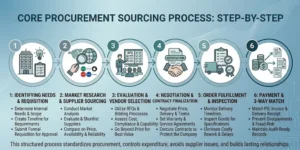
A good procurement sourcing process helps companies in controlling the expenditure, avoiding supplier issues and maintaining quality. Those companies with a structured working process reduce the number of mistakes and build relationships with suppliers that might help grow in the future. The steps also lead to the standardization of the procurement processes, which makes the process accountable in every department.
Step 1: Identifying Needs and Creating a Requisition
Any procurement cycle begins with an obvious internal need. Teams determine their requirements, the extent of their needs, and the timeline of their must-haves. Formal requisition assists in maintaining the request approved, recorded and within the project budgets.
Step 2: Market Research and Supplier Sourcing
After identifying the requirement, the procurement teams do market research and reduce the suppliers. They put companies in terms of prices, availability, delivery time and dependability of the suppliers. The step itself helps a lot to mitigate the risks and create the best value for the organization.
Step 3: Evaluation & Vendor Selection (RFQs and Bidding)
RFQs or competitive bidding are used by the procurement professionals in requesting quotations. They consider cost, compliance, technical capability, and previous performance of the suppliers. A good evaluation process also enables businesses not to choose vendors based on price factors only.
Step 4: Negotiation and Contract Finalization
Once a good vendor can identify that the next step here would be to negotiate with the vendor in terms of price, delivery time, payment terms, warranty and terms of service. The contracts protect the company and reduce conflicts in implementing projects.
Step 5: Order Fulfillment and Quality Inspection
After the order is placed it gets easier for the teams to keep an eye on the delivery and make sure that all is delivered in accordance with the agreed specifications. The check ensures exceptional quality of goods and eliminates the possibility of costly rework, time wastage or project interference.
Step 6: Payment and Record Keeping a 3-Way Match
The final step involves ensuring that payment is done properly by comparing the purchase order, invoice and the delivery receipt. It can remove overpayments, fraud risk and discrepancies in the records, and ensure that the records are audit-ready.
Key Benefits of Procurement Process Optimization for Modern Businesses
Through the improvement of procurement, companies save money, acquire control, speed, and clarity in all projects. An organized system will minimize confusion, increase supplier accountability and facilitate smarter financial planning. These changes in operations are necessitated in 2026, particularly in the industries that have to deal with multiple vendors and intricate schedules.
Stronger Transparency and Compliance Control
Streamlined procurement eradicates hidden expenditures and unapproved purchases. The automated processes maximize the speed at which the requisitions are made, the selection of vendors and the formulation of the purchase orders. The teams can continuously track the progress, reduce human errors and ensure procurement is operating without disrupting the project implementation.
Faster Turnaround Through Automation
Manual procurement is time-consuming due to the repetitive nature of approvals, following up over emails and delays in paperwork. The automated processes optimize the speed of requisitions, the choice of vendors and the creation of the purchase orders. Teams are able to monitor progress in real time, minimize human mistakes and keep procurement running without slowing down the project execution.
Best Practices for a Smarter Procurement Sourcing Process in 2026
Procurement in 2026 requires more than just a simple vendor selection. Firms have turned to competing in terms of speed, smarter sourcing and improved supplier relationships. By enhancing their procurement sourcing process, businesses can cut waste, improve quality and develop procurement systems that contribute to long-term profitability.
Use Digital Tools and AI for Smarter Spend Control
The modern procurement departments are using automation and AI to monitor the expenditure trends, predict the costs, and reveal price discrepancies. The AI-based tools assist buyers in comparing suppliers within a shorter period of time and reveal unnecessary costs before they ruin the budget. The digital transformation also enhances approval processes and maintains purchase monitoring in real-time.
Build Sustainability Into Supplier Selection (ESG Focus)
Sustainability has become an issue of great concern in the global industries in terms of procurement. Firms have transitioned to suppliers who practice good labor, reduce carbon emissions and materials that are environmentally friendly. Good ESG sourcing protects the brand name and increases compliance with international regulations.
Measure Performance Through Procurement KPIs
The procurement teams require the proper measures of performance to enhance decision-making. KPIs such as supplier lead time, compliance rate in contracts, cost savings per project, and accuracy of orders assist companies in understanding areas of weakness and maximizing purchasing efficiency. Constant measurement guarantees continuous improvement rather than recurrent errors.
Most firms liaise with providers offering industry-focused procurement solutions in order to be competitive. This is especially true within the construction sector, hospitality, and large-scale infrastructure; sourcing decisions directly affect the quality and the schedule of the project.
Additional Considerations in Modern Procurement Strategy
Modern procurement encompasses more than just purchasing decisions. Firms have come up with systems that combine procurement with design, operations and long term planning to improve efficiency and reduce costs throughout the lifecycle. This change will help businesses to prevent last minute sourcing issues and to improve coordination across the different departments.
Aligning Procurement with Project Design and Planning
Effective businesses do not use procurement planning as an end-stage strategy but rather as one of the initial stages in the design phase. The method enables the teams to predict the material requirements, minimize the change orders, and enhance the precision of the budgets. Early collaboration of procurement teams with the project managers helps in the establishment of a smoother process and reduces delays in the execution process.
Long-Term Cost Control and Lifecycle Thinking
Smart procurement puts emphasis on the total cost of ownership rather than merely the initial pricing. Before making their final purchases, businesses take into consideration the cost of maintenance, life, reliability of their suppliers and time of replacement. This long orientation of the orientation improves financial planning and enables sustainable project outcomes.
Strategic Integration with Industry Operations
Organizations that integrate procurement and operating strategy have more effective control over the timelines and resource allocation. As a case in point, during construction and large-scale facility development, sourcing decisions need to be aligned with FFE and OSE considerations in long-term planning to lower the redesign costs and enhance efficiency in the installation process during project phases.
Digital Visibility and Supplier Collaboration
Online procurement solutions also allow businesses complete access to supplier performance, order monitoring, and compliance with contracts. This openness enhances communication with suppliers and minimizes confusion, which results in delays or arguments. Close cooperation also contributes to the improved pricing deals and priority services of producers.
Risk Management and Supply Chain Stability
The current procurement systems can detect risks at an early stage through the analysis of suppliers’ performance, geopolitical conditions, and market dynamics. Companies that develop diversified supplier networks are not dependent on certain suppliers and are stable even in times of disruptions. This is a proactive action that ensures the projects are on track and running.
Conclusion
An effectively-structured procurement process has a direct impact on the profitability of the project, efficiency of the operations and business stability in the long-term. By having companies in charge of sourcing, vendor selection, contractual provisions and purchasing controls, companies reduce delays, prevent budget overruns and improve the performance of the suppliers. Good procurement also contributes to compliance and all departments are aligned with the financial goals.
In the current competitive business landscape, procurement is not a business routine but a strategic business investment that determines business success. This is why companies collaborate with experts like Delta Gulf Overseas, who provide services based on consistent and industry-based procurement solutions that aid in more intelligent planning, enhanced cost management, and effective supply chain performance.
Frequently Asked Question
Why is the procurement process easy?
The procurement process is an incremental process that companies use to purchase goods or services. It is about identifying the needs, selecting suppliers, contract negotiation, making orders, quality control and payment. This is a systematic procedure that helps companies to control costs and reduce the risk of supply.
What are the documents used in procurement?
Purchase requisitions, RFQs, purchase orders, contracts, delivery notes, invoices and inspection reports are some of the most prevalent procurement documents. These files ensure proper approvals, proper communication with suppliers and proper records to perform audits and compliance.
Why is procurement important to project success?
Procurement ensures that the correct materials, services and equipment are provided at the appropriate time and at the appropriate cost. It also helps to prevent delays, reduce cost overruns, increase supplier accountability and help in facilitating project implementation in construction, hospitality and manufacturing sectors.
What is the difference between purchasing and procurement?
Procurement is interested in the whole process of sourcing and supplier management, planning, assessment of the vendor, negotiation, and compliance. The last purchase process may be considered as purchasing and involves order and payment.
What should businesses do to be more efficient in procurement in 2026?
To enhance procurement, businesses can utilize automation tools, conduct spend analysis with AI, monitor supplier KPIs, and establish long-term relationships with vendors. Digital systems minimize manual errors and accelerate approvals to enable teams to make smarter and faster sourcing decisions.
What are the most prevalent procurement issues?
Businesses usually experience supplier delays and fluctuating prices, contract problems, quality delivery lapses, and unauthorized expenditures. An organized procurement process can mitigate these risks by enhancing transparency, vendor selection, and cost control.