


It occurs in nearly every industry: individuals treat purchasing and procurement as though they are interchangeable. Superficially, both appear the same. After all, both of them are about acquiring goods or services on behalf of the company. However, there is a catch to it; mixing them up can cost an organization a lot more than money. It may impact efficiency, supplier credibility, and regulatory adherence.
Purchasing involves transactions. It is the process of purchasing, receiving orders, and making payments. Procurement, however, digs deeper. It’s strategic. It entails selecting the appropriate suppliers, advanced planning, negotiation of the superior terms, and matching expenditure with the overall objectives of a whole project or a business. Both are needed but have quite different influences. Studies demonstrate the importance of this disparity.
According to Bain & Company, the procurement strategies of companies save between 8 and 12% more on a yearly basis than companies failing to implement them.
It is not a small margin. It is the type of saving that enhances competitiveness in retail markets and makes large-scale projects efficient. The effect is not just financial. Effective procurement procedures bring sanity to intricate procedures. They ensure industry standards are met, costs are kept within limits, and quality is attained. In the meantime, the progress of procurement technology and automation is making these processes even more efficient, limiting the errors of manual labor and increasing their speed.
Definition and basics of purchasing and procurement
Knowing the basics of purchasing and procurement blows away the confusion between the two processes that often get muddled up. They are both vital in ensuring projects are on schedule, although at significantly different levels.
What is Procurement?
The big picture is procurement. It is not all about purchasing but rather strategy development. It begins with the identification of needs and concludes with long-lasting relationships with suppliers. Consider it as the basis of wiser business decisions.
It discusses strategic sourcing, where businesses seek suppliers who will provide value not only in terms of low prices in the long term. It also involves vendor management, wherein relationships are fostered to achieve reliability, innovation, and compliance. This is followed by the contract management that does not bring undue contract terms and eliminates risks in the future. More and more often, sustainability in the sphere of procurement is also involved in the plan, as companies want to have suppliers that share their aims in terms of ethical and environmental concerns. Procurement is foresight. When it is done effectively, it influences cost-effectiveness, quality management, and the capability of enduring supply chain shocks.
Bain and Company estimates that in the case of world-class procurement functions, procurement costs can be reduced by 8-12 % and, on top of this, the organization attains a further 2-3 % of annual savings.
That is not a competitive advantage based on guesswork; it is a competitive advantage based on planning.
What is Purchasing?
Purchasing is less sweeping, but not less significant. It is the commercial aspect of the matter. This is where we do the actual purchase.
It involves performing and authorizing purchase orders, processing invoices, and row matching of purchase orders to goods received. It is also closely connected with accounts payable automation, in which suppliers are paid promptly, but the cash flow is maintained. Wise buying benefits budgeting and spend control as it enables teams to understand where the money was spent and how it aligned to project requirements.
If procurement sets the strategy, purchasing is the execution. These are the transactions, invoices, and approvals that work towards bringing in the success of the greater scheme. With both of them in line, businesses will achieve control, elimination of waste, and project running without any unnecessary delays.
Difference Between Procurement and Purchasing
Although purchasing and procurement are among the terms that go hand in hand, they cannot be interchanged. Procurement thinks big picture, and purchasing deals with the day-to-day.
The differences would be easily noticed in a side-by-side view:
| Aspect | procurement | purchasing |
|---|---|---|
| Scope | Strategic | Transactional |
| Goal | long term value | Short-term fulfillment |
| Includes | Market research, spend analytics, supplier vetting, compliance | Order placement, payment, goods receiving |
| Example | Energy sector supply chain planning | Buying replacement parts |
This systematic look brings out the contrast. Procurement is all about vision, market research, analytics, and supplier relationships that are concerned with long-term interest protection. Purchasing is also about action next: the execution of the order, paying, and making sure things will be delivered as expected.
The combination of the two acts as complements. Without procurement, transactions lose strategy. Without purchasing, the strategy never moves into action.
The Procurement Process
At Delta Gulf Overseas, procurement is not merely buying. It is a systematic process that links all the stages of work, including the original request, and hints towards a strategy. This process is cost-effective, enhances compliance, and develops stronger supplier relationships when observed accordingly.
1. Purchase requests
All this starts with a request. A project team stipulates in clear terms what it requires. This prevents confusion in later stages.
2. Budget check management
The request is compared to available budgets. This provides a safeguard on the financial discipline so that the spending helps in the planned priorities.
3. Strategic sourcing /supplier evaluation
Suppliers are not selected randomly. They are studied, compared, and tested in terms of quality, reliability, and cost-effectiveness. Strategic sourcing also considers the vendor innovation and long-term fit.
4. Contract management & compliance checks
There are fair terms on contracts. All the legal, tax, ESG, and regulatory requirements are screened. This limits risks and enhances compliance.
5. Purchase order and approval
When they have reached agreements, purchase orders are prepared. Money is not spent blindly, but rather it passes through approvals, which makes it visible and controlled.
6. Receiving process & inspection
Services or goods are received. The examination of quality authenticates the reliability of everything delivered in line with expectations and specifications.
7. Invoice matching/ PO matching
Purchase orders and receipts are matched with invoices. This will give accuracy and avoid duplication of payments.
8. Automation of accounts payable
The payments are made, and often automated. This shortens the cycle, reduces possible manual errors, and keeps the suppliers happy.
9. Spend analytics / spend insights
Data is then reviewed. Analytics helps reveal the cost trend, spending pattern, and ways to streamline future procurement.
The usefulness of this process is tried and true. Funnel example: Walmart reduced its sourcing expenses by 5-15% by implementing the direct sourcing process, which saved it between 4-15 billion dollars (Wikipedia).
In large-scale projects, such disciplined phases in procurement are not merely good practices; they are the difference between cost escalations and competitive advantage.
Best Practices for Procurement & Purchasing
Delta Gulf Overseas recognizes that good procurement and purchasing are not a matter of steps. They are concerned with the implementation of the best practices that stimulate efficiency, compliance, and long-term value. The following are Some of the Proven Strategies:
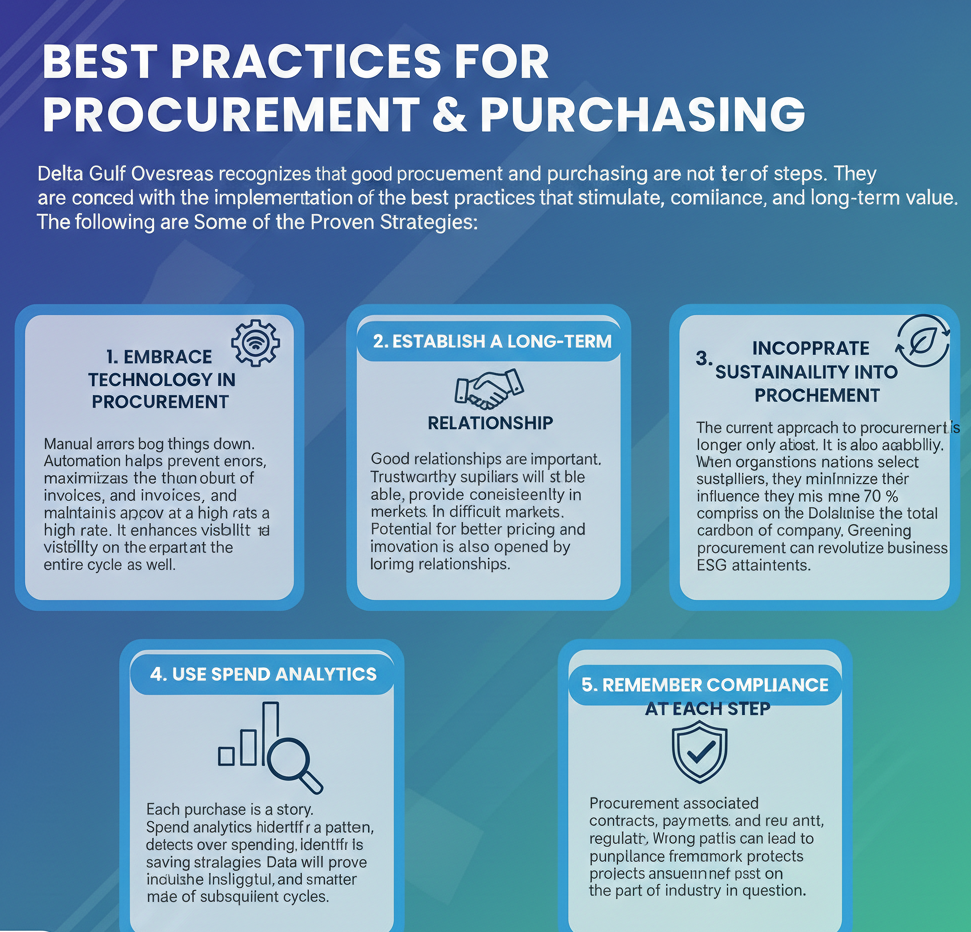
1. Embrace technology in procurement
Manual errors bog things down. Automation helps prevent errors, maximizes the throughput of invoices, and maintains approvals at a high rate. It enhances visibility on the entire cycle as well.
2. Establish a long-term supplier relationship
Good relationships are important. Trustworthy suppliers will be able to provide consistently in difficult markets. Potential for better pricing and innovation is also opened by long-term relationships.
3. Incorporate sustainability into procurement
The current approach to procurement is no longer only about cost. It is also about responsibility. When organisations select sustainable suppliers, they minimise their negative influence on the environment.
According to Deloitte and WSJ, Scope 3 emissions may comprise more than 70 % of the total carbon footprint of a company. Greening procurement can revolutionize business ESG attainments.
4. Use spend analytics
Each purchase is a story. Spend analytics help identify the pattern, detects over spending, and identify the saving strategies. Data will prove insightful, and smarter decisions will be made in subsequent cycles.
5. Remember compliance at each step
Procurement is associated with contracts, payments, and regulations. Wrong paths can lead to punishment or delays in the project. An organised compliance framework protects projects and ensures trustworthiness on the part of the industry in question.
At Delta Gulf Overseas, these are the foundations of the approach to procurement management. They strike the right balance between speed and strategy, compliance and cost savings, and short-term actions and long-term objectives.
Real-World Industry Applications
The process of procurement and purchase is not the same size-fits-all. The nature of every industry has its issues, priorities, and compliance demands. At Delta Gulf Overseas, we have experienced the ways that customized strategies can either see a successful project running smoothly or costly hold-ups.
The following are some of the important applications:
Supply chain planning in the energy sector
Most energy projects have long lead times along with stringent regulatory checks. Strategic procurement involves vetting of suppliers, ensuring compliance, and seeing equipment at the right time to keep projects on track.
FFE and OSE planning in project management
During the construction of a hotel, it is very important to carry out the procurement of the Furniture, Fixtures and Equipment (FFE) and Operating supplies and equipment (OSE). Purchasing practices here directly affect handover dates of projects and guest-ready openings.
Effective procurement for office setups
Procurement assists businesses to establish their offices as fast as possible and within their budget by fulfilling the needs of technology hardware and furniture orders. Bulk sourcing and vendor management lower down the prices whilst maintaining quality.
Housing project procurement strategies
When it comes to large houses, mass construction needs mass materials; the mass materials can consist of bricks and mortar, cement, steel, and finishing products. Strategic procurement achieves cost savings by taking advantage of low prices due to bulk buying and alleviates the risks of suffering from delays.
Specialized procurement in healthcare
Healthcare projects require accuracy. The challenge includes sterile supply chain, regulatory approvals, and time-sensitive deliveries. The procurement policies in this regard are safety-oriented, compliant, and reliable.
In all these examples, it is seen how procurement aligns itself with the industry it is serving. Delta Gulf Overseas assists organizations to attain compliance, efficiency, and savings even in the most complicated environments by aligning the strategy to meet the particular needs of a project.
Competitive Advantages of a Strategic Procurement Approach
An effective procurement strategy serves a purpose beyond ensuring projects continue to run; it allows one to achieve a competitive advantage. Those organizations that involve themselves with strategic procurement always perform better than those that engage in mere transactions. In Delta Gulf Overseas it is a difference that we observe every day.
Cost savings
The average world-class procurement practices yield savings of 8-12 per cent. Such savings can unlock the budgets for innovation, expansion, and expansionary investments.
Enhanced quality control & compliance
Strategic procurement has high standards. Compliance is incorporated, and not added as a bow-on measure: from regulatory congruency to protecting contracts. The performance of checking up on areas such as the materials and services used to meet a project’s needs is conducted at each level.
Improved supplier resiliency
The supplier networks are tested by unexpected disruptions. Through good relations with vendors, firms are able to have dependable logistics, perhaps in a turbulent market. This ability safeguards projects in times when others are lagging.
Data-driven decision-making
Spend management tools offer information that creates wiser strategies. Analytics depict the movement of the money, reveal the risk, and establish new possibilities of efficiency. The decisions are proactive, not reactive.
Sustainability as a priority
By aligning procurement to the sustainability goals, one will not have cost savings at the expense of responsibility. Organizations mitigate Scope 3 emissions, satisfy ESG requirements, and establish reputations that can be trusted in the international business environment.
At Delta Gulf Overseas, these benefits are not hype; it is what we achieve. Our ability to create strategic foresight and deliver that translates into our ability to work with clients to reduce the costs, to remain compliant, and to construct resilient supply chains. The current competitive environment does not make procurement a mere function anymore. It is a choice that outlines growth, sustainability, and success.
Conclusion
Purchasing and procurement are usually mistaken for being the same, but their functions are distinct and complementary. Handing of the procedures is done through purchasing, and strategy is driven through procurement. The combination helps to maintain efficiency, compliance, and affordability of projects.
Procurement, when treated strategically, has much more than cost-cutting ability. It is quality assured, enhances networks with its suppliers, and is sustainable in all its steps. Such benefits are translated into residential and long-term success, particularly in challenging projects.
Delta Gulf Overseas is a specialist in developing procurement strategies that are specific to industry issues in areas such as energy, housing, and healthcare, to mention a few. Assuming that your organization has big projects in the offing, then our expertise can assist in savings unlocking, enhanced compliance, and putting operations into context by focusing on sustainability.
Frequently Asked Questions
What is the difference between purchasing and procurement?
Purchasing is transactional in nature, meaning that it involves order placement, invoices, and supplier payments. Procurement is strategic. Procurement encompasses sourcing, supplier management, contracts, and integration of purchases to long-range objectives. Both are imperative, but to different extents.
How can procurement technology improve efficiency?
The procurement technology automates mundane tasks such as matching invoices and approvals, and tracking spending. This minimizes errors in handling processes, increases the speed of procedures, and enhances visibility in the supply chain.
What KPIs should businesses track in procurement?
Cost savings, supplier performance, compliance rates, purchase order cycle time, and level of spend under management are key KPIs. Monitoring them enables them to detect the inefficiencies and quantify the contribution of procurement to overall performance.
How do Scope 3 emissions relate to procurement?
Scope 3 emissions can be defined as the indirect emissions through suppliers, transportation of goods, and outsourced activities. Sustainable sourcing is a direct way to minimize these emissions, as the procurement decisions decide which vendor to select, every organization will be able to meet its ESG targets.
What are the best practices for building long-term supplier relationships?
Best practices involve open communication, equitable contracts, punctual payment, and open planning. Companies that put money into trust and reliability tend to get better prices, priority supply, and earn more resilience in supply chains.