Simply speaking, it is the management of contracts between buyers and suppliers. It includes all drafting and signing to tracking, reviewing and ensuring that both parties adhere to the terms of the contract. Procurement Tactics and Aavenir is not merely paperwork but more of value assurance, compliance, and project delivery.
In construction, this position is even more crucial. Projects are multi-contracted, in terms of suppliers of raw materials, equipment rentals, and subcontractors. When such agreements cannot be managed effectively, delays, conflicts, or budget problems can emerge rapidly. Effective contract management helps to keep projects on track, save costs, and mitigate risk.
In the modern world, an increasing number of companies also shift towards digital contract monitoring tools. The sources involve less effort in storing, tracking, and updating agreements in real time. As construction advances to become more dynamic and time sensitive, the use of digital is enabling teams to handle contracts more effectively than ever before.
Construction Management Procurement Definition
Contract management in procurement refers to the generation, implementation and control of contracts between buyers and suppliers. It makes sure that both parties give what they have agreed to provide, and in the expected time, within the given budget. This is necessary in construction since there are several vendors, subcontractors, and service providers in each construction project.
Difference between Contract Management and Procurement
The process of the selection of suppliers, negotiation of prices, and the purchase is referred to as procurement. Contract management then begins, ensuring such agreements are adhered to and modified as appropriate. They are interrelated; however, contract management is concerned with long-term performance and compliance.
What is Contract Lifecycle Management (CLM)
Multilateral adoption of CLM encompasses the full contract life process, that is, including the pre-award process, including planning, drafting and negotiation, through to the post-award phases of monitoring, performance verification and renewal. This is a lifecycle that can be applied in the construction and contracting of projects to avert risks, and it also provides clarity in each of its stages. Effective contract management results in cost savings as well.
Bain and Company has discovered that procurement organizations at the world-class level can cut the purchasing price by 8-12%. Such savings are usually due to well-structured deals, improved supplier performance, and a reduction in disputes.
Key Stages of Contract Management
Procurement of contracts is carried out in two phases: pre-award and post-award.
- Pre-award encompasses everything before the signing of the deal- planning, supplier selection and negotiation.
- Post-award begins after the contract is signed. This involves monitoring of performance and management of alterations, and ultimately renewal or disposition.
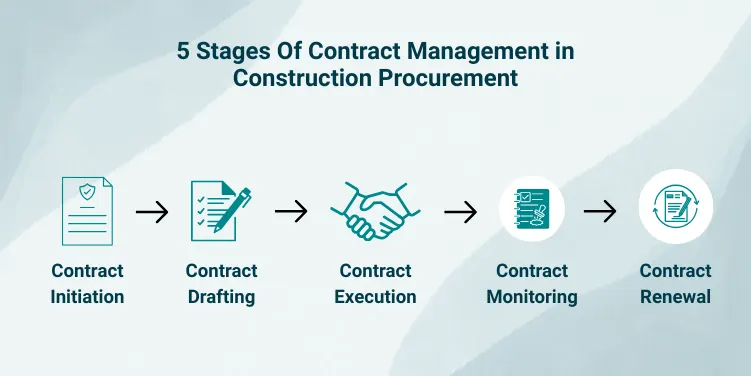
Both are significant in the context of construction since even a very high-quality contract is merely useless if not managed appropriately. These are the key steps that will be most important in construction projects:
1. Contract Initiation
This is the stage of defining the needs. As an example, a contractor may determine whether to use Design-Bid-Build or a Design-Build approach. The option determines the entire structure of the contract.
2. Contract Drafting and Negotiations
Clear terms are put down. This is in terms of cost, schedules, quality requirements and accountabilities. Here, also Service Level Agreements (SLA) and Key Performance Indicators (KPI) are framed to prevent future disputes.
3. Contract Execution
A Contract is signed after both sides reach an agreement, and the project is implemented. In construction, this might be received by a supplier of steel beams or a subcontractor that begins electrical work.
4. Contract Monitoring
This is where the actual test comes in. The performance is monitored with respect to the agreed KPIs and SLAs. Take the instance of whether the delivery of materials is on time or not.
Does it meet the standards?
Monitoring acts as a check and raises red flags in advance of risks.
5. Contract Renewal or Closure
The final phase is a contract, either renewal, extension or termination. The project lessons learnt are documented to enhance upcoming contracts.
What are the key aspects of contract management in construction procurement?
The key phases include initiation, writing and negotiation, implementation, monitoring and extension or termination. Collectively, they guarantee the smooth delivery of projects, budgeting, and adherence. The problem with Design-Bid-Build (separate design and construction contract) vs. Design-Build (Integrated cost management contract) in building construction illustrates why contract management is important. The approach you take transforms the way in which contracts are operationalized, tracked, and renegotiated.
You may also like our blog on the Importance of Procurement Management.
The Role of Contract Management in Construction Procurement
Construction Management Procurement
Construction management procurement is a focal point. All projects rely on well-formatted agreements that set schedules, budgets and the roles. Any delay of even a minor nature without proper management can reverberate as a cost overrun and disagreement. Intense processes are essential to ensure compliance, minimise risks and place suppliers under check.
Procurement Manager Construction
In construction procurement managers are at the epicenter of contract management. Their role is more than just buying up the materials or employing subcontractors, but also throughout the life of a contract. This involves the preparation of agreements, negotiation and supervising suppliers implementing agreements.
The major responsibilities of them are:
- Compliance ensures contracts are legal and upgraded in decisions of any specific industry.
- Supplier Negotiations getting rightful pricing and quality assurances.
- Contract Governance maintaining documents updated and transparent.
- Risk Mitigation early identification of risks and elimination of costly disputes.
Early Contractor Involvement (ECI)
A relevant case here is Early Contractor Involvement (ECI). The act of engaging the contractors at the planning phase of every project ensures that the project benefits from practical knowledge before the design is finalized. As a result, this can usually be more cost-effective and quicker. Late-stage surprises are averted with ECI, and therefore, many construction firms now prefer the use of ECI.
What is early contract involvement (ECI) and why is it so good?
ECI refers to engaging contractors to input in the planning and design phases as opposed to after the construction works have started. It assists in the earlier identification of risks, enhances an accurate cost estimation, and, in most cases, minimizes project delays.
✅Do You Know?
The magnitude of savings could be large. The Financial Times has been estimating savings of at least £500 million annually with better management of procurement in the United Kingdom. A good portion of it derives from better contract management and supplier performance.
Interested in what a procurement manager actually does?
Check out our blog on the Top 10 Roles of a Procurement Manager in an Organization.
4 Benefits of Contract Management in Procurement
At this point, it should become obvious that contract management does not include paperwork. It defines cost and risk mitigation as well as the efficiency of any project.
The question must then be asked: What are construction teams getting with Contract Management in Procurement? Let us break down some major benefits.
1. Cost Savings and Efficiency
Properly handled contracts minimize the conflict and maintain more stable budgets. Transparency of terms implies less surprise, and time frames remain practical.
ProcurementTactics survey of CPOs lists cost savings as the priority of the procurement process among 46% of its respondents. In construction jobs where cost is always tight, each conflict avoided and every purchase optimized is a winner.
How much savings does well-executed contract management have to offer in construction?
The savings can usually be viewed as fewer misspent and delays to the better use of resources. In the long run, this translates to millions in cost savings in huge projects.
In Delta Gulf Overseas, we do not only consider cost savings as discounts but also long-term efficiency savings. With a systematic method of contract management, the companies have smooth work, quicker approvals, and predictable expenditure. The savings are multiplied on multiple projects when combined with energy and industrial procurement solutions.
2. Risk Mitigation
All construction contracts have risks: the risks of delays, government regulations, or environmental problems. Effective contract management guarantees adherence to the laws and safety codes, as well as the ESG framework.
According to Deloitte WSJ, Scope 3 can make up more than 70% of a company’s carbon footprint. It is possible to align the construction companies with sustainability goals by incorporating the ESG provisions into supplier contracts.
Delta Gulf Overseas focuses on contract arrangements where sustainable procurement practices in healthcare construction are incorporated. This not only minimizes risks but also puts the projects to face numerical changes in the regulation.
3. Transparency and Accountability
Contract Governance is enhanced through effective monitoring of contracts. This implies that each change, approval, or dispute is recorded clearly. Clarity favours the client and the contractor. It also helps to recoup the costs in cases of things that go wrong. To give an example, poor performance by a supplier may allow good governance to recover the money paid or ensure a replacement without incurring severe losses.
It is also inextricably linked with FFE and OSE considerations in long-term strategy, even the introduction of detailed contracts helps to avoid leaking costs in the face of planned future project phases.
How does contract governance help recover costs?
Maintaining clear terms and records assures that claims and disputes arising are given a fair outcome, and it can go a long way to avoid unnecessary loss to the company.
4. Improved Supplier relationships
Contracts do not exist merely as legal constructions but determine the framework of cooperation. With transparent terms and closer monitoring, the suppliers will feel that they are valued, and trust will also be built over time. This develops allied relationships rather than single transactions.
Wikipedia Studies indicate that the supplier relationship management systems have the potential to unlock 10-30% savings. They are usually made through improved pricing plus priority delivery, and shared problem-solving.
At Delta Gulf Overseas, we assist our customers in developing long-term supplier relationships, particularly with partners that offer full scope procurement for hospitality projects and in other sectors.
Digital Contract Management in Construction
The fact of the matter is that the construction industry is fast-moving toward the use of digital tools in procurement and contract monitoring. With multiple suppliers, subcontractors and timelines to manage, there is no way that the manual systems will suffice anymore. This is where construction procurement digital tools enter the scene. Contract management is being changed due to AI and automation.
The Art of Procurement suggests that up to 80% of CPOs worldwide are aiming to implement Gen AI into procurement in the next 3 years. In construction, it translates into quicker contract drawing, sensible bargaining and real-time analytics that minimize risk.
The major advantages are the following:
- Contract Repository: all contracts in one location with the ability to access them at any time.
- Analytics Dashboards: providing visibility into spend trends, supplier performance, and exposures to procurement teams.
- Real-Time Monitoring: automatic reminders of deadlines, renewals or compliance checks, all details covering that aspect.
Delta Gulf Overseas aids construction companies in implementing such digital tools, including contract analytics and spend visibility. In such a way, companies that take care of efficient sourcing in office and residential developments can be sure that all decisions are supported by data rather than guesses.
Why is digital contract management an important tool in construction procurement?
Due to increased velocity of processes, better transparency and a smaller number of errors. With Procurement teams using digital CLM tools, they can more effectively manage contracts, monitor real-time compliance and gain insights to make better project choices.
Real World Application in Construction Projects
Theory is one thing, but what counts when it comes to contract management is the reality of what it brings to the actual construction. The procurement manager, as a construction professional, lives it each day procuring supplier agreements to have the operational systems in place to monitor compliance. Well-established contract management results in superior outcomes on all cost, speed, and sustainability dimensions.
Negotiating Cost Savings
In a mega project, the slightest percentage in material prices may make a difference in millions. Experienced procurement managers utilize the provisions of the contract with them to negotiate bulk discounts or obtain steady prices irrespective of the vagaries of the market. To illustrate an instance, fixing the price of steel or cement contracts allows the project to avoid inflation. These negotiations save a lot of money over time, which can be expended on other important aspects.
Quicker Execution using Digital Tools
There is never a lack of pressure on construction schedules. One delay has the power to set other stages back. Digital CLM tools now provide teams with an advantage. The procurement teams decrease approval bottlenecks with more advanced alerts, central storage, and real-time performance monitoring.
📝 The result?
More timely delivery of materials, reduced interruptions and project takeovers. Several companies implementing the systems under discussion express a desire to reduce the procurement cycle intervals and enhance the predictability of the timing.
Final Thoughts
What is Contract Management in Procurement?
In essence, it is the means through which contracts are created, tracked and managed to maintain a smooth flow of projects, supplier product or service delivery, as well as the ability of the budget to be contained. Within the construction industry, where there is the interplay of various stakeholders, stringent deadlines and high investments, this study plays out like a game changer.
Effective Contract Management can bring Tangible Rewards:
Cost reduction, minimising risks, improved compliance, and improved supplier relationships. It makes projects accountable, transparent and informed in relation to the sustainability plans. In the case of construction, a legal agreement is not the only thing that matters to construction teams, but a trust-building process, where delivery is achieved. The companies should shift to the pattern of orderly approaches and digital provisions to facilitate contract governance easily and more intelligently to remain competitive.
Why Builders Trust Delta Gulf Overseas For Project Success?
At Delta Gulf Overseas, we can assist customers in a variety of construction and contracting services, which helps them to procure streamlined and manage their contracts efficiently. Today, taking a structured approach will lead to fewer add-ons, shorter schedules and more sustainable results tomorrow.
Frequently Asked Questions
What are the main stages of contract management in construction procurement?
Its main phases are initiation, drafting and negotiation, execution, monitoring and renewal or closure. Properly combined, they properly make contracts explicit, risks controllable and a project in line.
What cost savings can well-implemented contract management deliver in construction?
Good contract management minimizes disputes, holdups, and wastes. Cost reductions are usually in the form of favourable terms with suppliers, effective work processes, and fewer penalties. On large projects, its potential savings in dollars can be in the millions as both direct and indirect costs.
What is early contractor involvement (ECI), and why is it beneficial?
ECI is where the contractors are brought on board at the planning phase, rather than during construction. This assists in early detection of risks, better cost estimations and shorter project schedules. It decreases surprises and assists in easy delivery.
How does contract governance aid in recovering costs?
Through good governance, all activities of the contract are monitored. When a supplier defaults, it is more convenient to claim money back or impose fines due to a clear record. This safeguards the spending of any project and avoids wastage.
Why is digital contract management vital in construction procurement?
In construction, there can be numerous contracts simultaneously. They can be stored, tracked, and monitored in real time, with the help of Digital Contract Lifecycle Management (CLM) tools. They lessen bottlenecks, enhance transparency, and accelerate decision-making, which makes them essential in contemporary construction procurement.