In today’s high-stakes industries where delays cost millions and compliance is non-negotiable. Hence, success begins long before the first contract is signed or the first purchase order is placed. Success or disorder in large-scale projects across hospitality, construction and industrial sectors depends heavily on attention to detail.
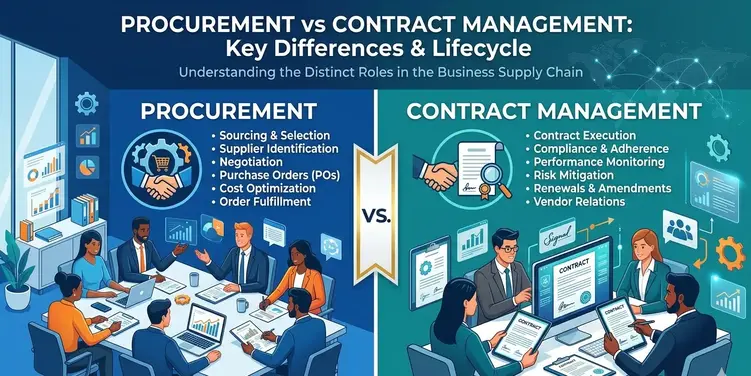
Project efficiency derives from two insufficiently focused yet fundamental aspects, which are Procurement vs Contract Management. These aren’t just corporate buzzwords; they’re the backbone of cost control, compliance and timely delivery.
Let’s break it down.
Procurement is More Than Just Buying
Procurement is not just about purchasing. In fact, it’s about building the proper foundation. Imagine trying to construct hotels, launch restaurants or operate oil and gas facilities without the essential materials, equipment and vendors in place. It becomes nearly impossible to move forward without these critical resources. That’s where procurement steps in.
At its core, procurement is a strategic function. The project needs to begin the process that leads to supplier acquisition tasks. These tasks involve negotiations and delivery management for products and services. This process becomes significantly complex when applied to Construction Management Procurement. Each selection must perfectly align with project periods, expense plans, security protocols and future project worth.
Today’s procurement professionals must adhere to additional requirements to source sustainable project materials. ESG (environmental, social governance) commitments have become essential for business operations, so companies need suppliers whose values correspond to theirs. Companies must adopt sustainable procurement practices that represent fundamental material selection standards.
Contract Management Keeping Everything on Track
Now that you’ve sealed the deal, what next?
This is where contract management takes over. The procurement strategy requires execution through contract management. This verification process enforces the completion of real-world tasks according to contracted agreements. It involves checking deliverables, assessing legal requirements, resolving disputes, and conducting performance monitoring
The best procurement methods will collapse when organizations lack proper oversight of contractual agreements. Because contract governance remains undefined, all risks escalate, including delays, extra costs, and missing obligations. That’s why strong contract management systems, dashboards, and communication protocols are fundamental for project control and future problem prevention. Understanding the roles of procurement and contract can save your business time, money and stress. Because a complete partnership between these management functions helps prevent miscommunication incidents.
Here’s a comparison table for Procurement between Contract Management:
| Aspect | Procurement | Contract Management |
|---|---|---|
| Lifecycle Stage | Begins pre-award; includes needs analysis, supplier evaluation, and negotiations | Starts post-award; focuses on execution, compliance, monitoring, and renewals |
| Primary Focus | Cost savings, supplier selection, and quality assurance | Fulfilling contract terms, reducing risk, and resolving conflicts |
| Key Performance Indicators (KPIs) | Cost variance, supplier lead time, and purchase order cycle time | Compliance rate, SLA adherence, renewal success rate, and penalty avoidance |
| Skill Sets Required | Market analysis, negotiation, and cost modeling | Legal literacy, relationship management, and performance monitoring |
| Technology and Tools | E-sourcing tools, P2P platforms, and supplier portals | CLM systems, automated alerts, and audit-ready repositories |
| Collaboration Handoffs | Structured handover to contract management for smooth transition | Relies on communication and shared dashboards to stay aligned with procurement |
| Risks of Poor Execution | Delays, cost overruns, and poor supplier performance | Legal risks, compliance failures, missed financial opportunities, and operational delays |
Sure, the challenges are real, but they’re far from deal-breakers. Next, we’ll explore how smart procurement management and contract management coordination can turn chaos into clarity and open the door to faster wins and long-term growth.
Why Procurement Management and Contract Management Roles Matter More Than You Think?
Let’s be honest: Every successful project has two invisible engines running quietly in the background: innovative procurement and airtight contract management. Clients frequently view only the end result, such as a tastefully decorated hotel, a well-stocked restaurant, or a recently opened office. Nevertheless, they fail to notice the collaboration occurring behind the scenes. These results come from strong operational collaboration between two essential teams. Because Procurement and Contract aren’t just operations. These functions act as strategic success drivers that maintain schedule compliance, budget adherence and quality expectations.
A Powerful Duo Vendor Selection vs. Execution
The journey starts with procurement. Procurement professionals are responsible for selecting suppliers and negotiating terms, ensuring the financial worth of projects.
They’re the ones asking: who can deliver the right quality on time and within budget?
However, contract management ensures those promises become deliverables once the deals are signed.
Contract management becomes the lead player by ensuring that all promises made in the deals finally translate into actual deliverables. Vendor selection is the starting point from which project execution is received by obligation management to sustain the development process.
These separate roles and joint work practices allow stakeholders to prevent operational breakdowns in high-risk industries where revenue is lost every second. These managers are the backbone of performance, accountability, and risk control.
SRM The Secret Sauce of Long-Term Value
Finding the right vendor is only half the battle; keeping that relationship strong is where the real value lies. That’s where Supplier Relationship Management (SRM) comes in. After a signed contract, the victory handshake represents only a segment of what SRM accomplishes. Organizations actively use this approach to build strong partnerships. At the same time, it helps improve performance and secure better pricing. It also promotes innovation and long-term reliability.
SRM generates strategic value for all companies that handle continuous or repeated projects. This process lets procurement teams create trust throughout relationships while foreseeing future difficulties and finding suitable suppliers to match changing project requirements. Industry sectors operating under stringent deadlines alongside demanding clients greatly value the benefits of process flexibility this technique delivers.
FF&E and OS&E Sourcing Management When Quality Meets Procurement
This process of furnishing hotels and opening restaurants requires detailed coordination of multiple items without permitting any error to occur. That’s where FF&E and OS&E Procurement Management demonstrate their worth in this particular situation. Every property item requiring installation follows an exact procurement process. This includes finding sources and making all necessary scheduling arrangements before distribution and final assembly.
The management of FF&E and OS&E requires hospitality leaders to create a balance between design quality and cost efficiency. In addition to satisfying delivery deadlines for hotels and restaurants at any complexity level. Specialized procurement teams serving this area grasp the vital importance of their Work because they convert architectural plans into ready-to-use guest accommodations. When skilled contract management partners with this approach, this process functions flawlessly for clients.
Now that we’ve covered the essentials therefore we will dive deeper into what separates both management. In this section, we’ll highlight the key differences between their responsibilities and areas of focus. Moreover, we will show how each makes a substantial and different contribution to the projects success.
Key Differences in Focus and Responsibility
Lifecycle Stage
Every successful project develops foundations before the product is delivered or any vendor joins the contract. This procurement process launches the journey in the pre-award stage by requiring precise strategic thinking and forecasts from identifying what’s needed, evaluating suppliers and gathering quotes to negotiating the best possible terms. This is where cost-saving opportunities and value creation begin. Restaurant FF&E Project Management requires procurement experts to contact design and operations groups to obtain deal furnishings, fixtures and equipment that meet project timetables, brand requirements and spending limitations. The project vision starts materializing due to paper documentation, supplier collaboration, and quote acquisition.
The inspection of that vision starts after the signature dries on the documents. This is where contract management takes over at the post-award stage. The vendor selection process ends since now the focus switches to vendor performance standards. Post-award contract management ensures the implementation of procurement agreements by maintaining compliance tracking, following schedule expectations, and fulfilling renewal and performance metrics. Contract managers retain the strategy procurement by shifting it from concept to practical results.
Primary Objectives
What’s the real goal behind procurement? It’s not just about placing orders. In fact, it’s about maximizing value. Total procurement functions aim to obtain minimal costs, suitable vendors and excellent initial product quality as its primary targets.The core foundation of dependable execution results from their effective negotiations and expert supplier knowledge. In areas like spa equipment procurement, equipment cost, brand reputation and service support are all factors. Smart procurement decisions can save clients tens of thousands while delivering a premium experience.
But once the deal is done, who ensures that promises made are promises kept? That’s the job of contract management. Helping to safeguard contractual obligations while minimizing risks and handling disputes before major conflicts develop is the primary focus of contract management.
According to the International Association for Contract and Commercial Management deficient contract control measures result in losses equivalent to 9% of annual business revenue, making this operation tremendously essential. The buying cost reductions procurement offers later become protected through ongoing contract management support.
Key Performance Indicators (KPIs)
If you can’t measure it then you can’t manage it. Thus, procurement metrics dedmonstrate value-driven performance alongside efficiency and rapid delivery aspects. The fundamental KPIs in procurement help managers observe cost variations and supplier delivery speeds, as well as purchasing process timelines to maintain affordable and timely resource acquisition. Applying these key performance indicators in high-pressure projects like office fixtures and equipment installation determines the difference between successful and efficient setups and expensive project delays.
But what about after the deal is signed? That’s where contract management KPIs take the spotlight. The critical indicators for your business include compliance standards and Service Level Agreements, renewals and penalty mitigation. The indicators show how your contracts perform during execution time as they demonstrate vendor compliance with their responsibilities. Deloitte reveals that 57% of professionals face challenges using manual contract procedures which results in delayed deadlines, lost possibilities and increased risk. Your project safety derives from proper contract KPIs, illuminating the operational weaknesses that automated oversight can eliminate.
Skill Sets and Stakeholders
What does it take to build the perfect procurement strategy? It requires market analysis, negotiation tactics and cost modeling. The procurement team needs capacities to analyze market patterns while locating dependable vendors so they can construct bargains that provide affordable solutions within project parameters. Project profitability depends on their successful cost forecasting ability and ability to negotiate favorable terms. The ability of procurement specialists to achieve competitive pricing and supplier-quality standards functions as their primary role in completing acquisitions. Experts in this field lay vital operational guidelines determining a project’s financial outcomes.
Conversely, contract management requires an entirely different set of skills. Procurement sets strategic sourcing as its core strength. Still, contract managers deliver a thorough legal understanding and combined relationship management and performance tracking abilities. Contract managers serve to support the enforcement of contracts yet focus mainly on establishing reliable vendor relationships that grow from long-term partnerships. Tracking contract performance and compliance functions enables managers to preserve procurement agreements throughout the project.
Technology and Tools
In today’s fast-paced business world, technology isn’t just a luxury. It’s a necessity. The principal task for procurement staff involves optimizing their processes to achieve maximum efficiency goals. E-sourcing systems and purchase-to-pay (P2P) platforms alongside supplier portals solve these needs. These procurement tools empower professionals to execute efficient product sourcing and handle purchasing orders through simple computer-based operations while tracking supplier results. The result? E-sourcing and purchase-to-pay platforms with supplier portals allow organizations to achieve faster decision-making while building better supplier relationships and generating significant cost savings.
On the other hand, the contract management system implements complex tools that keep contracts compliant and protect against potential threats. The central role of Contract Lifecycle Management (CLM) systems ensures smooth contract oversight because they handle every contract development stage between negotiations through renewal. CLM systems allow contract managers to monitor all contract details because they contain alert automation for pressing deadlines alongside audit-prepared data storage for compliance tracking. The management path remains challenging throughout the process.
World Commerce and Contracting reports that 81% of organizations fail to monitor all their contract obligations, which creates significant vulnerability to business expenses through minor oversights..
Collaboration Handoffs
What happens when teams aren’t aligned? Can a lack of proper communication lead to delayed deliveries and avoidable expensive mistakes? Building a well planned transitional process ensures these management functions are in perfect synchronization. After procurement finishes its responsibilities that include vendor selection and deal terms discussion and agreement so the Work remains active.
The transition to control management should be straightforward and organized to guarantee that every detail is transferred. Guaranteeing project success demands that the handoff deliver comprehensive materials needed for contract implementation to the following team members.
But how do you ensure that this handoff goes smoothly every time? The answer lies in clear communication protocols and shared dashboards. Through these tools both teams can access important information in real time as they share the same platform which provides continual access to critical timelines and updates. The combination of relationships between these management teams proves most essential in projects with time constraints and demanding requirements, such as construction sites and hotel fittings. The relationship between procurement management and contract management teams produces more efficient projects by reducing client project duration while enhancing their results.
Understanding the differences is crucial, but poor execution can lead to serious risks. Next, we’ll highlight the dangers of mismanagement and how they can impact your bottom line.
Risks of Poor Execution The Cost of Neglecting Contract Management
Did you know poor contract management can cost your company up to 9% of its annual revenue? According to the International Association for Contract and Commercial Management (IACCM) specifies that businesses experience these financial losses because of poor contract oversight practices. Professional delays in project execution happen because of manual processes that slow contract execution. According to Deloitte data, 57% of professionals face such delays. The financial consequences together with operational risks become massive when contracts receive inadequate management. Look deeper into the key risks businesses face when contract management falls short.
Legal and Compliance Risks
Poor contract oversight can result in serious non-compliance with laws and regulations. A well-established system remains crucial to prevent companies from accidentally missing essential legal requirements since it helps them fulfill regulatory obligations. A business that neglects proper contract oversight can face judicial action, which triggers expensive lawsuits along with monetary penalties. Companies can prevent compliance matters that threaten their operations through proper contract management by transparently executing legal requirements.
Missed Financial Opportunities
What if your contracts could be optimized for better savings or additional revenue? In many cases, businesses that fail to renegotiate contract terms or secure savings opportunities through poor contract management lose potential financial benefits. Your organization risks spending unnecessary money when it maintains outdated agreements because it fails to perform routine reviews together with performance tracking. Strategic management identifies each possible opportunity to decrease costs and boost revenue, directly affecting business profits.
Operational Delays
Have you ever faced delays because the contract terms weren’t clear or properly executed? Unfortunately, project schedules and operational processes experience significant delays when contract information remains unclear. These unclear terms and specifications that define delivery performance create misalignment among supply chain personnel. This eventually leads to stakeholders’ frustration because of late deliveries. Contract execution optimization reduces delays to help initiatives advance steadily according to their scheduled timetable.
Inefficiencies in Performance Monitoring
How can you measure success if you don’t track performance? Contract management without proper organization makes it possible to check for supplier and vendor compliance with their contractual agreements. Several important metrics including delivery deadlines and service level agreements (SLAs) may be missed which forces businesses to respond to specific problems too late. Due to absent performance tracking mechanisms, your business will face sustained negative consequences from supplier relationship deterioration and operational inefficiencies.
Increased Disputes
When you first read the name, consider it an energetic dispute. But to your surprise, it’s not true.
Because improper handling of contract execution and definition between vendors and clients leads to various disputes. The existence of unclear terms in contracts generates disagreements regarding deliverables as well as deadlines and payment conditions. Which evolve into serious legal conflicts. Such relationships are adversely impacted when the company loses resources and experiences time consumption. Preventing contract disputes alongside explicit agreement of all terms produces better vendor and client relationships.
Data Security Issues
Companies in the present digital era require absolute protection of their data. Business information risks breaches when contract management fails to supply appropriate storage methods with encryption protocols. Unauthorized access to sensitive data brings serious financial consequences and unfavorable changes to organizational reputation. Companies that establish robust contract management systems create secure data storage solutions. This data safeguards contracts against breaches and unauthorized persons accessing sensitive information.
Reputation Damage
One of the most overlooked risks of poor contract execution is the damage to your business’s reputation. Flawed contract compliance, late deadline fulfillment, and below-average work performance will shape an adverse customer impression. Your customers and suppliers will doubt your delivery potential, thus leading both parties to rethink their business partnerships and damaging your company’s brand reputation. A well-managed contract execution process protects a business’s reputation and builds market trust for clients and partners.
Lost Renewal Opportunities
Renewing existing contracts gives organizations vital chances to get improved terms or taste supplier prices while prolonging their partnerships with essential suppliers. Businesses fail to capture renewal opportunities because they do not handle their contracts effectively, which results in inadequate new agreements. Businesses prioritizing continuous contract performance and timeline management will secure improved arrangements with essential suppliers or clients.
Therefore, organizations must adopt strong contract management practices to protect their business while ensuring continued success. Understanding these risks makes the costs of improper execution obvious, so businesses should implement simple yet efficient contract management systems for future business protection.
The good news? Today’s technology is built to solve exactly these challenges. Now, we will explore how modern tools transform these management, bringing clarity, control and confidence to every process stage.
Tech in Modern Procurement Management and Contract Management
In a fast-paced business world where spreadsheet and paper-based procedural systems no longer provide sufficient solutions. From supply chains to contract execution, every step must be transparent, automated and intelligently optimized. This is where technology becomes a game-changer that enables teams to move from reactive management toward proactive control with excellent precision.
ERP & CLM Systems that are the Digital Backbone
Enterprise Resource Planning (ERP) systems and Contract Lifecycle Management (CLM) tools are now essential to modern operations. The unified data platform of ERPs links procurement information between sourcing activities, purchasing functions and financial management, thus it creates instant actionable spend insights. Meanwhile, CLM software strengthens the contract lifecycle through the entire operational cycle from the initial draft to the final expiration point to prevent significant obligations from getting hidden among emails and file folders. Together, they enhance accountability, reduce manual errors, and build audit-ready systems that instill confidence.
End-to-End Integration Means Source-to-Contract vs Procure-to-Pay
What’s more powerful than digital tools? Seamless integration. When S2C processes link up with P2P workflows, organizations gain complete control across their spending cycle. This combined approach enables procurement professionals to maintain the same precision as legal and financial teams during tracking and compliance management. The integrated approach leads to reduced decision times, fewer risks and unified outcomes between different departments.
E‑Signatures and Digital Contracts Approvals at Lighting Speed
Still waiting for a proper signature?
Digital contracts and e-signatures remove the bottlenecks from your approval cycles. The process that used to take days is now completed in under a minute without compromising document security or lowering version control capabilities. The system generates audit-ready trails that eliminate file loss and ambiguous editing activities. This approach results in faster operations combined with stronger security and demonstrates superior intelligence in business processes.
AI-Driven Insights Smarter Spend and Lower Risk
Imagine having an assistant who spots risks before they happen. AI-powered analytics in sourcing and contract management do precisely that. The analytics tools conduct automated spending categorization as well as detect compliance breaches and score supplier risk factors and forecast contract violations. AI-driven tools provide both enhanced decision-making powers as well as protection for the complete procurement strategy design.
Why Digital Transformation Is No Longer Optional
According to World Commerce and Contracting, 81% of companies still lack complete visibility into contract obligations. That’s not just a tech issue but also a strategic risk. This represents both a technology problem and a strategic danger to the organization. Automation tools, real-time alert systems and active compliance tracking features have become an absolute need rather than a secondary functionality. All organizations that want flexible business operations and governance must implement these features as essential operational components.
In fact, the optimal connection between Procurement vs Contract Managemen temerges through technological systems, which improve communication and speed alongside complete transparency. The implementation of technology allows procurement departments and legal teams to follow identical operating standards while performing day-to-day activities.
But technology alone isn’t the full solution therefore it’s how you use it that counts. In the next section, we’ll cover best practices to seamlessly integrate sourcing and contract management to turning tools into real results.

Best Practices for Seamless Integration
Ever wonder why even the best contracts or procurement strategies can fail? The main reason behind project failure can stem from poor team integration rather than deficient tool sets or personnel abilities. The two functions should work together as a unified organization instead of remaining as separate departments. When procurement vs contract becomes a battle instead of a collaboration, costly gaps, missed opportunities and compliance risks will follow. But it doesn’t have to be that way.
Align Teams Early, Not After the Contract is Signed
The timeline of team integration between procurement and legal determines the quantity of unexpected findings in subsequent project periods. Collaboration shouldn’t start when the ink is about to dry; it should begin when project requirements are defined. This early proactive alignment results in legal bus,iness, and vendor capability-responsive documents that satisfy all requirements.
Straightforward Role Assignment Eliminates Confusion
Who owns what? It may sound simple, but the roles of procurement teams and contract management teams must be clearly defined. When these boundaries are unclear then it can lead to duplicated Work. Even worse critical milestones in the process may be missed. Assignments of responsibilities need to happen at the beginning of every process. Contract managers ensure vendor compliance and performance monitoring after the procurement team completes vendor selection and negotiation steps.
Define Ownership Across Contract Milestones
Contracts go through multiple stages from drafting and review to execution and renewal and someone must be accountable for each. Every stage requires designated accountability for smooth transitions, thereby preventing the disappearance of responsibilities. Operational scalability and delay reduction require such clarity in processes.
Centralize Everything with the Right Tech
A powerful way to unify Procurement vs Contract processes? A single platform should link all functions including sourcing, together with legal finance and operations to operate as one. Integrated platforms that combine robust ERPs with specialized CLM tools enable total transparency in data tracking while accelerating decision-making through single-access documentation.
Standardize for Speed and Consistency
Why start from scratch every time? Adopt standardized contract templates and pre-approved clause libraries. This technique reduces negotiation timelines and maintains uniformity between all vendor agreements. It decreases law-related risks and simplifies vendor onboarding procedures, particularly in developing business sectors like Oil & Gas Procurement and Procurement in the Hotel Industry.
Audit-Ready Systems and Shared KPIs
Keep your documentation centralized and audit-ready. Generating one integrated secure system for document storage establishes automatic compliance features that are easily accessible to all users. Bonus tip? The organisation should implement joint Key Performance Indicators (KPIs) between procurement teams and contract management to achieve alignment in their operational performance. Shared goals between teams create performance accountability because all parties track mutual success indicators, no matter if they are supplier delivery metrics or renewal success rates.
Don’t Forget Change Management
Change is inevitable, especially in dynamic projects like Construction Management sourcing or FF&E and OS&E sourcing Management. That’s why it’s critical to establish structured change management protocols. The procedure includes a standardized workflow for contract modifications, document version tracking, and approval processes to maintain consistent alignment throughout organization-wide changes in scope and terms.
Smooth integration sets the stage, but measuring impact is where the real progress happens. Next, we’ll dive into the metrics that truly matter and how they turn strategy into measurable success.
Performance Metrics and Optimization
What’s the secret to transforming sourcing and agreement management from cost centers into strategic powerhouses? The answer relates to a single critical component known as metrics. Without proper performance indicators, your organization cannot improve itself since measurements drive all improvement initiatives.
Procurement KPIs That Drive Real Value
Procurement success goes far beyond securing the lowest price. The organization’s goals receive support through measurable value generation. That’s why Cost savings constitute only the foundational element in the procurement process. Supplier diversity tracking enables organizations to meet diverse ESG requirements alongside time cycle performance measurement to ensure efficient sourcing operations. These KPIs combine to identify operational weaknesses, which enables organizations to discover new methods for process improvement and enhanced business competition.
Contract KPIs: Where Compliance Meets Strategy
Once a contract is signed, the real Work begins, and this is where contract KPIs shine. Your organization requires a complete understanding of performance regarding contract obligations,k reduction, and superior management of renewals. The combination of compliance rate, renewal efficiency, and value realization confirms that you achieve both contract management excellence and optimal contract value delivery. KPIs reveal substandard vendor performance by displaying unrealized savings opportunities that guide parties toward better renewal or renegotiation choices.
Bridging Strategic Goals with Accountability
Shared KPIs between sourcing and contract management create a unified system that connects the preparation work of sourcing to the actual operational performance post-award. KPIs, as universal success measurement tools, enable the management of restaurant FF&E project operations, spa equipment sourcing and enterprise-wide sourcing operations.
Want to hit your goals faster, reduce risk and increase ROI? Start by aligning your performance metrics. That’s how the transformation from data into strategy works through results.
Knowing the metrics is powerful but applying them to real-world projects is what brings it all to life. Here’s how Delta Gulf Overseas puts these strategies into action to drive results across industries.
Why It Matters for Delta Gulf Overseas
What effect does the combination of exact execution with methodology implementation through strategic integration produce? The processing at Delta Gulf Overseas produces substantial financial benefits with no project delays and back-to-back client trust relationships. Delta Gulf Overseas applies procurement and contract management collaboration in daily practice to achieve measurable positive results.
Real Impact of A Mini Case Study
In a recent 500-room Hotel FF&E project, Delta Gulf Overseas was tasked with outfitting a luxury property under a tight deadline and budget. The challenge? Before this initiative, supplier delays alongside increased costs emerged due to poor coordination between the sourcing stage and the contract execution step. We established a single procedure for vendor selection to final delivery by initially bringing sourcing and contract management teams together.
The streamlined communication approach and term-compliance protection allowed real-time tracking capabilities. The result? The hotel opened on time, while the case goods procurement generated significant cost savings and resulted in seamless delivery across the board, so we established a new standard for project achievement.
A Strategic Bridge, Not a Gap
Our organization operates procurement and agreement functions as a connected whole instead of independent divisions. Delta Gulf Overseas delivers a seamless platform that removes communication misunderstandings and time inefficiencies in sourcing and execution functions. Our alignment system lets clients obtain faster turnaround times and better compliance standards while achieving maximum value.
Our approach unites each procurement process from its beginning until completion for all types of procurement including Procurement in Hotel Industry, complex industrial sourcing and construction management sourcing. By simplifying complex requirements into scalable outcomes, we can manage scope creep and control cost overruns.
Serving Industries That Demand Precision
We deliver sector-specific solutions from Spa Equipment sourcing and Restaurant FF&E Project operations specifically addressing industries requiring precise timing accuracy and detailed project management. Our team operates through unified tools together with distributed dashboards and real-time communication to maintain absolute awareness of every project detail.
Delta Gulf Overseas isn’t just a service provider. In fact, we’re a performance partner. The perfect alignment between sourcing and contract operations produces lasting operational excellence and project success.
Delta Gulf Overseas shows that success follows when procurement and agreement management align. Let’s wrap it up and highlight why this alignment is your key to staying ahead.
Conclusion:
Wrapping It All Together From Silos to Synergy
Teams that make slight adjustments in their collaboration practices might discover extensive cost reductions and risk minimization. That’s why the symbiotic work relationship between sourcing and Contract management emerges from properly defining their roles before integrating their functions.
This strategic requirement for superior procurement and agreement team collaboration has replaced the optional approach. Any organizational attempt to make lines indistinguishable between departments creates compliance problems, resulting in increased costs and the potential failure to miss opportunities. But when they clearly draw those lines and build a bridge between them? The operational field benefits from better governance and result-driven budget savings have become a reality.
The combination of procurement and contract management functions operated as integrated operational units creates organizations that function quickly and provide measurable financial returns.
In the end, Contract drafting and a more innovative purchasing approach only constitute one piece of the puzzle because you need to enable both contracting parties to reach their peak performance. And that’s where your organization truly begins to scale with confidence.
Frequently Asked Questions
How do sourcing and contract management differ?
While often intertwined procurement focuses on sourcing, negotiating and purchasing goods or services before a contract is signed. In business, procurement functions as the agreement designer, whereas contract management transforms the concept into operational reality.
Why is Supplier Relationship Management (SRM) important?
Properly executing the SRM methodology ensures effective vendor relationships that lead to high productivity between companies. The system provides open communication with vendors, which delivers goods promptly with top-quality services while building trust relationships that lead to superior pricing, quick issue fixes, and lasting customer value.
What are key performance indicators (KPIs) in procurement?
The leading procurement performance indicators consist of cost reductions, time savings, diverse supplier involvement and standardized delivery durations from suppliers. These metrics serve organizations to monitor both purchasing effectiveness and supplier operational abilities.
Why is change management crucial in contract administration?
Change will naturally occur in project work, but without proper management, these changes could trigger legal disputes and expense overruns. The change management system implements necessary steps to properly document, approve, and monitor contractual modifications in scope, deadlines, and pricing.