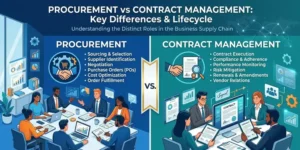
Two of the pillars in the smooth running of businesses include procurement and supply chain management. Procurement means locating and purchasing the products/services correctly, and supply chain management encompasses all the processes, including the original product or commodity, to the end user. Both are valuable to the understanding of any business that desires to operate efficiently and remain competitive. In the practical world, such processes determine whether shelves remain stocked or production lines continue flowing.
In the case of manufacturing giants and global retailers, the performance of such systems in harmony is a major key to success. Industry reports presented by the Chartered Institute of Procurement & Supply (CIPS) and the Council of Supply Chain Management Professionals (CSCMP) indicate that well-defined strategies in either direction would save money, enhance quality, and build links with both vendors and consumers.
What is Procurement?
Procurement involves searching, purchasing, and administering the goods or services that a company requires in order to conduct business. It goes beyond the purchase, and it is actually a coordinated process and is known as the procurement lifecycle. The typical lifecycle goes in this order: RFI (Request for Information), RFP (Request for Proposal), and RFQ (Request for Quotation).
- RFI helps to obtain the minimum information about the suppliers and be aware of the existing options.
- RFP allows business organizations to request a detailed proposal in order to compare quality, price, and schedules.
- RFQ aims at obtaining precise price quotes for the required goods or services.
Every step is important since it contributes to risk minimization, value maximization, and the elimination of future troubles. Procurement also involves contract negotiation or the process of arriving at fair terms favorable to the buyer as well as to the supplier. The other key component is supplier relationship management, which is concerned with the creation of trust and good communication. Good relationships would allow securing better prices, priority service, and more solutions in a short time when problems arise.
Indeed, supplier relationship management systems have the potential to unlock 10-30 percent of savings among organizations (Wikipedia).
The industry-focused procurement solutions facilitate the process in industries like construction, healthcare, and manufacturing. It gives assurance that not only will the businesses receive what they need, but also establish long-term partnerships to enhance growth.
What is Supply Chain Management?
Supply Chain Management (SCM) involves planning, control, and enhancement of the movement of products and services. It begins with the acquisition of raw materials and stops with customers receiving the final product. SCM deals with inventory and logistics, demand forecasting, and supply chain collaboration among various partners.
The objective is easy: to ensure that products are in stock when they need to be and at the minimum cost without compromising the quality. What counts is efficiency, and also resilience. Companies need to be prepared to face unexpected circumstances, such as a shortage of supplies or delays in transportation. The supply chain visibility enables managers to know where goods are at any one time, notice issues early enough, and make a notification that leads to fast resolutions.
In 2023, the global supply chain management market is estimated at 21.95 billion dollars and is projected to hit 30.9 billion dollars by 2026 (Procurement Tactics).
This increase indicates the level of investment related to enhancing these processes. As an example, in construction and real estate, efficient sourcing of office and residential development projects can ensure the delivery of materials at the right time without delays, because delays are expensive. To retailers, this may imply that shelves remain stocked even during peak seasons. A properly run supply chain is much more than transportation.
Procurement vs. Supply Chain Management: Key Differences
At Delta Gulf Overseas, we observe that procurement and supply chain management are used interchangeably. The fact is, they are more like two gears in the same machine; connecting, yet each with its own work to do. Procurement involves the acquisition of what you require. Supply chain management is actually the process of getting whatever you have here to where it has to go without delay or excessive expenses.
Here’s a clear breakdown:
| Aspect | Procurement | Supply Chain Management |
|---|---|---|
| Main Focus | Buying goods or services at the best value | Overseeing the full journey from raw materials to delivery |
| Direct vs. Indirect | Direct procurement = buying materials for production; Indirect procurement = buying support items like office supplies or maintenance tools | Covers both direct and indirect items, plus their storage, movement, and delivery |
| Cash Flow Optimization | Secures better payment terms, bulk discounts, and cost savings from suppliers | Reduces warehousing costs, prevents overstocking, and speeds up delivery cycles |
| Risk Mitigation | Avoids supplier issues through contracts, compliance checks, and backup vendors | Plans for delays, shortages, transport risks, and demand changes |
| Key Tools | RFI, RFP, RFQ, contract negotiation, supplier relationship management | Inventory control, logistics planning, demand forecasting, supply chain collaboration |
How Delta Gulf Overseas Makes Them Work Together
That is where we want to establish our base in our projects; selecting the suppliers that are at the same quality levels as us, negotiating terms to our advantage to protect our client, and ensuring that all orders are placed on the right schedule. However, procurement is not the only thing. We are dealing with supply chain management, which makes those goods arrive at the site on time in the appropriate form. To illustrate, during a massive construction/hospitality project, we take charge of FFE and OSE considerations and supply chain planning, to make sure everything is put to charge.
Procurement and Supply Chain Management: Similarities
Although procurement and supply management processes involve various activities, their end goals remain similar as they sustain smooth operations, cost, and risk reduction. Consider them one system divided into two. When one goes slowly, then the other suffers. The two functions are oriented towards efficiency. Procurement teams ensure that businesses purchase applicable products or services at the opportune moment. The supply chain teams ensure such items are transported without any delays between the suppliers and the end users. Collectively, they ensure that there is no wastage of money, time, and resources.
They also possess the same objectives of cost reduction. Procurement accomplishes this by bulk purchasing, contract negotiation, and multi-year contracts between the company and the suppliers. Supply chain management minimizes expenses through optimum transport routes, efficient management of inventory, and also avoiding over-inventories and under-inventories. When a given team saves money, but the other causes delays or over-storage, the advantage is lost. A similar common interest is supplier risk management. Both the procurement teams and the supply chain teams evaluate the supply chain reliability of the suppliers, check regulation compliance, and document backups.
This is not a minor issue; any disruption in the supply chain and procurement costs an organization a mean of 1.5 million dollars per day (Procurement Tactics).
At Delta Gulf Overseas, we integrate the two functions into one strategy. We collaborate with partners that provide the possibility of full-scope procurement of projects in the hospitality industry, construction development, etc.
Strategic Importance in 2025 and Beyond
Global procurement and supply chain management is a rapidly developing world. Businesses in 2025 and onwards are concerned not only with speed and cost, but they are also just beginning to confront the new opportunities and challenges of sustainability, global risks, and market opportunities.
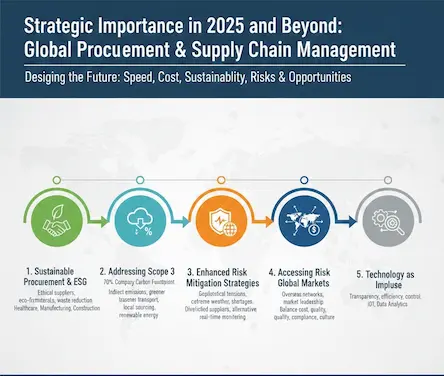
This is what is designing the future:
1. Sustainable Procurement and ESG
There is an increasing number of companies taking Environmental, Social, and Governance (ESG) objectives into consideration when making procurement decisions. This implies making decisions on working with suppliers that conduct business in an ethical manner, utilize environmentally-friendly materials, and minimize waste. Companies within industries such as healthcare, manufacturing, and construction are implementing sustainable procurement in healthcare and other industries to fulfill customer demands and satisfy regulatory requirements.
2. Addressing Scope 3 Emissions
Climate action is now focused on supply chains.
The annual amount of carbon emissions is more than 70 percent of the carbon footprint of a company (Deloitte WSJ).
They are the indirect emissions in the value chain of a company, between the extraction of raw materials and the use of the products. They are also measuring, reporting, and minimizing these emissions at the same time as procurement teams collaborate with supply chain managers. This could involve making greener transportation choices, using local supplies or suppliers, or vendors that utilize renewable energy.
3. Enhanced Risk Mitigation Strategies
There is no predictability in the global markets. Operations can go haywire in a single night due to the occurrence of political tensions, extreme weather events, and a shortage of raw materials. Companies are developing more robust risk management systems in order to be prepared. This involves another supplier base, maintaining alternative routes of logistics, as well as employing real-time monitoring of goods during shipments.
4. Accessing Global Markets
New markets are also opened up by international procurement and supply chain management. With a strong overseas supplier network, firms are able to service many customers, have access to competitive prices, and remain ahead of the competition in a particular country. But in such a case, the success depends on the ability to balance cost against quality, compliance, and cultural knowledge.
5. Technology as an impulse
Technology is being used to make the procurement and supply chain processes more transparent and efficient, allowing users to know more about what is being done and to have more control over the process as a whole. Companies that implement such tools will be overprepared in terms of costs, precision, and robustness.
The takeaway: Procurement and supply chain management in 2025 and beyond is no longer all about getting the job done. They are concerned about doing it responsibly, efficiently, and with a vision of global growth in the long-term direction.
Role of Technology and AI in Procurement & SCM
Technology has stopped being merely a supporting tool; rather, it has become a real power in the sphere of procurement and supply management. Sourcing, planning, and delivering are changing immensely through artificial intelligence, automation, and real-time analytics.
-
Smart Sourcing using AI
Using AI and automation in procurement is making sourcing quicker and more precise. Instead of spending the majority of their time scanning supplier databases or maybe comparing one contract against another manually, AI decreases labor and mistakes.
A survey by Art of Procurement found that 80 percent of CPOs around the world will implement generative AI in procurement within 3 years.
-
Optimal Spend Analysis and Visibility
Spend management is getting strategic with an AI dashboard. These systems record all dollars spent, point out any abnormal behavior, and indicate superior offers.
According to the Hackett Group, up to 10 percent cost, productivity, and quality improvements have been realized in the procurement teams piloting Gen AI use cases.
-
Supply Chain Efficiency using AI
In supply chain management, AI enhances the forecasting of demand, optimizes the inventory, and even forecasts possible delays before they occur. It implies that there will be fewer shortages, losses, and predictable deliveries.
Icertis estimates that by 2025, 90 percent of procurement leaders will implement AI agents to perform business activities such as contract and supplier risk management.
-
Industry-Specific Applications
At Delta Gulf Overseas, we combine such tools with industry-specific requirements, including niche procurement required in the energy industry, hospitality, and construction industries. Another example is in the energy sector, where AI will aid in finding the most stable suppliers of important components around the world and observing safety and sustainability conditions.
To sum up:
AI and automation have become a prerequisite in procurement and supply chain management. Companies that adopt them today will have better-controlled costs, quick decision-making, and competitive advantages in the worldwide markets.
Real-World Examples of Successful Procurement & SCM
The use of cost, quality, and time measure strategies is what makes procurement and supply chain management a true success. There are businesses that have perfected this balancing act around the world, and their performances indicate how potent the right approach can be.
1. Walmart Direct Sourcing Wins
Walmart has been regarded as efficient, and one of its greatest triumphs was in direct sourcing. The retail giant operationalized direct involvement with manufacturers and the elimination of any intermediary, saving it between 4 and 15 billion dollars (Wikipedia). This strategy accorded Walmart more control over prices, increased uniformity in the product, and quicker delivery to outlets.
2. Energy Sector: Securing Critical Components
In the energy business, sound sourcing may help avoid the shutdown, which proves to be expensive. Specifically at Delta Gulf Overseas, we have facilitated construction and contracting activities in Oman by making sure the specialized equipment and materials are there when they are required. As a respected procurement and contracting provider in Oman, we bring together local expertise of suppliers and an international supply chain to maintain projects on schedule and within budget.
3. Hospitality: Laison FFE& OSE Speed
The launch deadlines in hotels and resorts are very demanding. Hospitality projects are not subjected to last-minute shortages due to the fact that procurement of FFE (Furniture, Fixtures & Equipment ) is streamlined with accurate supply chain planning. This will imply that rooms are ready to host guests on the first day, instead of costly rush orders.
4. Construction: Timely Material Flow
When a large-scale construction is going on, material delays could cause stagnation of the work done. Organized purchase guarantees obtaining the suitable amount of cement, steel, or finishing material, which arrives at the given moment of the project, when it is necessary to avoid expensive downtime and storage costs.
5. Healthcare: Life-Saving Supply Reliability
In the medical industry, it is quite literally a matter of life and death as regards procurement and supply chain management. Hospitals that collaborate with suppliers in order to obtain medical equipment, medicines, and protective gear are prepared in the event of an accident without having excessive supplies of products that have a short shelf life.
Final Thoughts
The procurement and supply chain management are not other functions of business, but rather are the skeleton in the well-running operations. Once synergized, they will make sure that all purchases are in line with the bigger picture, all deliveries are within the deadline, and all projects are within budget. They collectively result in a system where cost efficiency, quality, and reliability go hand in hand.
At Delta Gulf Overseas, we use these functions as a related strategy. Our supply chain planners ensure that the products eventually arrive when and where they are required at the right price, and our procurement professionals ensure that they are obtaining the correct product at the right price. Our track record, be it in a construction project, launching a hospitality facility, supplying healthcare services, or supplying energy to the sector, has the accuracy and trust that the contemporary global markets require of us.
Do you want to cut costs, increase efficiency, and save time-wasting delays?
Then it is time that you work with a company that manages the entire journey sourcing to delivery. Talk to us now at Delta Gulf Overseas so that we can help you change the procurement and supply chain issues into growth.
Frequently Asked Questions
1. What are the key differences and similarities between procurement and supply chain management?
Procurement is concerned with the process of sourcing and purchasing the goods or services at the correct price and quality, whereas supply chain management is the process that covers everything, starting with raw materials, to delivery. Efficiency, cost reduction, and supplier risk management are some of the objectives shared by the two.
2. How is AI transforming procurement processes today?
AI is taking the vendors on the hunt, optimizing contract data mining, and enhancing spend learning. Art of Procurement predicts that 80 percent of world CPOs project to implement generative AI in procurement within 3 years, and The Hackett Group has measured up to 10 percent cost, productivity, and quality gains among teams currently testing AI.
3. What is the procurement lifecycle (e.g., RFI, RFP, RFQ), and why is it critical?
The procurement cycle: Procurement processes such as RFI ( Request For Information), RFP ( Request For Proposal), and RFQ ( Request For Quotation). These assist companies to collect information, make comparisons, and select the most desirable in terms of minimized risk and value on their money.
4. How can supplier relationship management systems save costs?
Supplier relationship management enhances communication, improves the establishment of trust, and better terms. Wikipedia lists that these systems can unlock between 10 and 30 percent savings through streamlined processes and partnerships.
5. Why is reducing Scope 3 emissions important in procurement?
They (scope 3 emissions) constitute most of the environmental footprint of a company, more than 70 percent of a firm’s carbon footprint (Deloitte WSJ). Reducing such emissions promotes the ability of businesses to achieve sustainability goals, enhance brand image, and adhere to climate policies subsisting globally.